
Monday, 21 August 2017

Pet of the month hall of fame - Tigger (June)

TIGGER

Our June pet of the month is the lovely Tigger who unfortunately got hit by a car about six weeks ago.  During a busy Friday evening we received a phone call from a lady who’d seen a cat get hit by a car. She’d managed to pick the cat up and came straight down to the surgery. Our nurses carried out an initial assessment. He was breathing rapidly and was very sore around his back end.Student nurse Avril checked him for a micro-chip and we were delighted when the scanner detected one. We found out his name was Tigger and we were able to get in touch with his owners.
Vet Joanna examined Tigger and concluded that he would need some x-rays taken as he was unable to stand on his hind legs. He would also need an x-ray of his chest and abdomen to check for internal injuries. Tigger’s condition was stable and with some pain relief he had a comfortable night. The following day vet Karolina sedated Tigger in order to take the x-rays. His chest x-ray was clear and importantly she could see that his bladder was intact.  Looking at the bones of his pelvis and hips, Karolina detected a pelvis fracture and a partial dislocation to the sacroiliac joint; this is where the pelvis attaches to the lower part of the spine (sacrum). 


Treatment for this type of injury depends on a number of factors. In Tigger's case we opted to treat him conservatively with confinement and rest. The pelvic bones are completely surrounded by large muscle masses which act as a natural splint to help keep the bones in place.The first most important step was to ensure that the nerves that run through the pelvis had not been damaged so that Tigger could still pass urine and faeces. Tigger was a very worried boy when in the hospital so we sent him home with strict cage rest,  with his owner's monitoring his toileting. We were pleased to hear that he'd managed to pass urine at home. Tigger came back in for a check up two days later and had been much happier out of the clinic, but he still required regular careful monitoring as he was having a bit of trouble passing motions and he was still not using his left leg. The vet was suspicious that Tigger's sciatic nerve might be damaged, but after discussing Tigger's injuries with a specialist orthopaedic surgeon it was decided to give Tigger more time rather than consider surgery. Often these types of injuries will improve on their own with just supportive treatment.


After 6 weeks of rest and TLC, Tigger is on the mend and doing really well, albeit still a little wobbly!

Monday, 19 June 2017

Rabbit awareness fortnight!

Calling all rabbit owners!


We are supporting rabbit awareness week by offering two weeks of free rabbit checks with a vet between Monday 19th June - Saturday 1st July.


Please call and book an appointment! 

This year's campaign is focusing on the importance of feeding hay - rabbits need 85 - 90% of good quality hay and fresh grass every day, that's equal to their body size every day!

    • HAY is high in fibre that promotes digestive health
    • HAY stimulates chewing which is good for dental health  
    • HAY encourages bunnies to forage for emotional health 
#hoptohay


Click on the link below for lots of bunny care advice and tips!                                                                                                                                                                                                                                                                                                                                                                                                                        

Friday, 9 June 2017

Pet of the Month Hall of Fame - Toby ( April)

Toby was first brought in to see vet Akvile because he had been sick and was not quite himself. After an examination, Toby was given some medication to settle his tummy and antibiotics to combat any infection. Toby also had a blood sample taken to help determine the potential causes of his symptoms. The blood test results gave Akvile an indication of how well Toby's organs were functioning and ruled out some conditions that can be present with the symptoms that Toby was showing. Toby was brought back in for check ups over the next few days. He was quite bright and alert and was no longer being sick although his appetite had not completely returned.  Toby then took a step backwards in his recovery and started to be sick again, so he was admitted to the hospital to be placed onto an intravenous drip and to have an x-ray taken of his abdomen.

Akvile was looking for signs of a foreign body or tumour in the gastrointestinal tract.  With nothing obvious detected from this, Toby remained in hospital on supportive treatment. Although no signs of an obstruction were seen on the x-ray, some foreign objects do not show up, so this could not be ruled out completely at this stage. Toby was gradually improving, he was no longer being sick and was eating more readily. He was happy to sit having cuddles with the nurses. Head vet Cathy reassessed Toby and although she was pleased with his progress, Cathy was still concerned that his tummy was a little tender when touched. After a chat with Toby's owner, Cathy decided to allow Toby home for a day to see how he got on but if he started to deteriorate again then he would need an exploratory operation to check for the cause.

Poor Toby was back in the next morning having been sick again so Cathy admitted him for the exploratory operation. Toby was given a general anaesthetic and taken into theatre where Cathy discovered a small corn on the cob in his stomach! The size of the cob meant that it was freely moving about in the stomach, causing a partial obstruction of the stomach outlet to the small intestines. This is why Toby's symptoms waxed and waned. 
Within a few hours of waking up from his operation to remove the foreign body, Toby was already a much happier boy and ate some chicken. One more night in hospital and Toby was ready to go home. Back at home, Toby continued to improve and he recently had his final check up with Cathy. We are so pleased that this lovely boy is all better. 

For being such a brave and sweet boy, Toby is our pet of the month!  


With the BBQ season not too far away, Toby's story is a reminder of the hazards that our pets can encounter if they eat something they shouldn't. Whether you are in the back garden, out on a picnic or indoors because of the weather, remind guests not to leave corn cobs and cooked bones sitting on their plates and ensure that you bag up leftovers and store them out of reach before disposal.

Wednesday, 17 May 2017

Charity Canoe Challenge!


Our head vet Cathy Siddle and her daughter Alison are embarking on a four day charity canoe trip along the Zambezi River! This water-safari challenge will take place between 2–10 September 2017. They'll be paddling 12–24km a day, but will have plenty of opportunity to marvel at the stunning landscapes of Zambia and get up close (but not too close!) to the incredible wildlife, whilst raising money for the worldwide veterinary service (WVS). They will also get to spend a day at an elephant orphanage in Lusaka that WVS supports, where many of these animals are rehabilitated, ready for their eventual release back to the wild. 

About the charity;

The Worldwide Veterinary Service (WVS) is a UK based charity which works to promote the welfare of animals on a global scale, as well as providing disaster emergency response. By collating veterinary resources and funds and helping with training and education of vets, they are able to provide a sustainable resource for deprived areas. They help to support over 800 smaller worldwide charities dealing with domesticated, feral and wild animals. In an average year around 150,000 animals are treated, 100 teams are deployed, 850 aid parcels are sent, 500 vets are trained and 250 charities are supported. 

From dog shelters in Thailand, to the welfare of donkeys in India, WVS are in action worldwide, running neutering and vaccination programmes, sending veterinary supplies out to animals in need as well as providing a fast action emergency response to animals affected by natural disasters or other life-changing situations.
If you would like to support both Cathy and Alison and their chosen charity, you can donate via their 'Just Giving' page  - simply click on the link below or drop into the practice. The money raised will go towards the charity's continued work in animal welfare.

JustGiving - Sponsor me now!    

  'thank-you for your support, every donation is greatly appreciated '- Cathy & Alison xx


Thursday, 6 April 2017

Indie, Pet of the month Feb 2017 - in memory of Indie


Indie who was our February pet of the month has sadly lost his battle with cancer. He was such a brave and happy boy and his story serves as a tribute to him.

Little Indie has been a regular visitor to our Ruislip hospital over the last couple of years. Back in July 2015, his owners were concerned to hear Indie wheezing as he was breathing so brought him in to see us. He required some tests to investigate his symptoms and he was diagnosed with feline asthma. He was given some treatment and to assess his progress, Indie needed to have some further chest x-rays taken. He was such a good patient throughout these visits. He responded well to the treatment that he continues to take daily. Then in Feb 2016, Indie was brought in for an urgent appointment as he was listless and howling as if uncomfortable. His owners had noticed that he’d been in and out of his litter tray a few times in the night. Indie was diagnosed with a blocked urethra (the tube that drains urine from the bladder out of the penis) resulting in him being unable to pass urine. This is a life threatening condition as the bladder becomes very full. Indie needed emergency treatment that involved blood tests to check for kidney function and other systemic imbalances, intravenous fluid therapy and placement of a urinary catheter to flush the urethra and remove the obstruction (inflammatory material/ crystals). We needed to sew the urinary catheter in place for a few days to allow Indie to pass urine whilst the inflammation in the urethra settled down. After we removed the catheter we were pleased to see that Indie was able to go to the toilet by himself and he was allowed home. Indie was again a super patient.  About a month ago, Indie came in for his routine check up but his owner mentioned that he seemed to be sleeping more than usual and they were concerned that he might be getting a cataract in his left eye. Vet Louise examined him and identified that Indie’s eye had an abnormal appearance. An ophthalmic examination identified a tumour to be the cause. Indie required surgery to have his eye removed, a procedure called enucleation. Before Indie was prepared   for surgery,  Louise carried out an ultrasound scan of his abdomen and x-rays of his chest to see if the tumour had spread to other organs. With the diagnostic imaging complete, Louise could see no definite signs of spread and Indie's owners elected to proceed with the operation. 
Indie's operation went well and he was soon up and about looking for cuddles (right). He recently came in to have his stitches removed and we are pleased to see that he is a happy boy. Sadly the results from the laboratory have told us that the type of tumour that Indie had removed is likely to spread. Louise is speaking to an oncologist to see if there are any other treatment options, but keeping Indie happy and enjoying life is most important.


Indie, a brave and affectionate, loving boy.  💙

Tuesday, 7 February 2017

Lula - Pet of the Month hall of fame

Over 2016 we have treated many lovely pets and sadly some very ill animals too, but we've had some happy endings and one such case is that of 3 year old Lula.

This super little dog has survived the odds after needing two major operations. Lula was diagnosed with a condition called a portosystemic shunt or liver shunt. This is where the normal flow of blood through the liver does not occur due to an abnormal connection between blood vessels. This means that the liver is prevented from doing its normal job of breaking down toxins. The toxins build up in the blood stream making the dog very ill. In Lula's case she was born with this. Medication can be given to support the liver, but the best solution is to surgically tie off the abnormal blood vessel, thus removing the shunt and restoring normal blood flow to the liver.Little Lula had the operation in August back in her owner's home country and was recovering well, but a few weeks later she was brought in to see vet Rachel after she lost her appetite and was very quiet.

Rachel carried out some tests and diagnosed that Lula had a uterus (womb) infection called Pyometra. This is a very serious condition that requires surgery but the risk of anaesthetic complications for Lula were high. Little Lula took a turn for the worse and collapsed. She was showing signs of shock and vet Katie suspected that Lula’s uterus had ruptured and pus was leaking out into her abdomen causing peritonitis.


Katie and the nursing team needed to work quickly and Lula was given a general anaesthetic and prepared for emergency surgery. Supported with intravenous fluids and antibiotics, Lula was taken into theatre. The nurses monitored Lula closely, ensuring that her heart rate, rhythm and breathing remained within a certain range as Katie carried out an ovariohysterectomy (removal of the uterus and ovaries). Katie then flushed Lula’s abdomen with a sterile saline solution in order to remove the infective material. Once out of surgery, the nurses continuously monitored Lula as she began to wake from the anaesthetic. Lula was still seriously ill but she gave us some encouraging signs, not least a little wag of her tail! Over the next few days, Lula continued to improve and was able to take a few steps around the garden. She was quite enjoying all the attention and deservedly-so. The day came for this brave, happy little girl to go home. We were so glad to see Lula back with her owners.

Tuesday, 3 January 2017

Pet of the month; Hall of fame - Jimmy


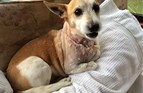
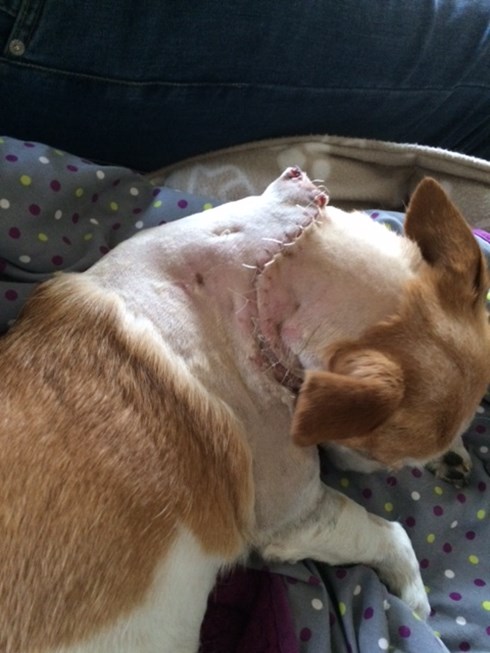
10 year old Jimmy is our brave pet of the month after a dog attack left him with a dreadful injury. Jimmy was rushed straight in to vet Rachel and it was apparent he'd sustained a large wound to the back of his neck and on his shoulder. Jimmy was admitted to the hospital where he was given pain relief and antibiotics, and placed onto an intravenous drip to treat shock.

Image Not Found
Vet Katie assessed Jimmy the following day and although he had received damage to the skin and soft tissue layers, the bite had not damaged vital structures in his neck or chest. He also had a few puncture wounds along his back. Due to the extent of Jimmy’s wound, Katie needed to give him a general anaesthetic so that she could treat the wound further. Because a dog’s mouth is full of bacteria, a bite wound will introduce bacteria to the wound, so firstly Katie thoroughly flushed the wound to reduce the bacteria in the tissues and remove visible dirt. She then checked the skin and tissues for their health and removed some damaged areas – a procedure called debridement. Katie had to reduce the dead space in the wound using stitches; Dead space is formed when the skin is pulled away from the underlying tissue creating a space. Poor Jimmy has likely been shaken  cause this wound.  When the space is large, as in Jimmy's case, fluid can accumulate under the skin once the wound is stitched closed and bacteria can thrive. To reduce this risk, Katie inserted a drain; a latex rubber tube that allows fluid to drain out of the wound. You can see the drain poking out the bottom of Jimmy's wound (see picture above).

The following day brave Jimmy was feeling a bit brighter and the nurses took him outside for a potter around the garden. His wound looked good and the nurses encouraged him to eat with some freshly cooked chicken. Jimmy’s owners felt confident to have him at home, so they came and collected him later that evening. He came back in over the next two days to have his wound checked and the drain removed. We were really happy with how well Jimmy was getting on especially as there can be complications with infection and the breakdown of stitches.

Katie saw Jimmy back for his next visit and was able to remove some of his many stitches. He continued to do well and two weeks after his initial visit, Jimmy had the last of his stitches removed. We are so pleased with the recovery he’s made.


What a super little dog he is!-Well done Jimmy!